
The CEO’s Hardest Decision May Be Deciding What to Stop

CEOs are surrounded by opportunities. New markets. New products. New customers. New technology. Acquisitions. Partnerships. Transformation programmes. Cost initiatives. Growth bets.
Every function has something that should be added to the agenda. Every senior leader has a reason why their priority matters. Every external adviser arrives with another opportunity worth considering.
Very few people ask the harder question:
What should come off the agenda?
That matters because organisations have a finite amount of everything that matters most.
Finite capital. Finite leadership attention. Finite management capacity. Finite time. Most importantly, a finite number of exceptional people.
Every time a CEO says yes to another priority, some of that capacity is committed somewhere else.
That is the part of strategy we often underestimate.
Every yes contains a no.
THE PORTFOLIO OF COMPROMISES
Every initiative has an owner. Every project has history. Every strategy has someone who championed it. Every customer has a relationship. Every product has a story. Every senior executive has something they believe should continue.
Organisations accumulate commitments.
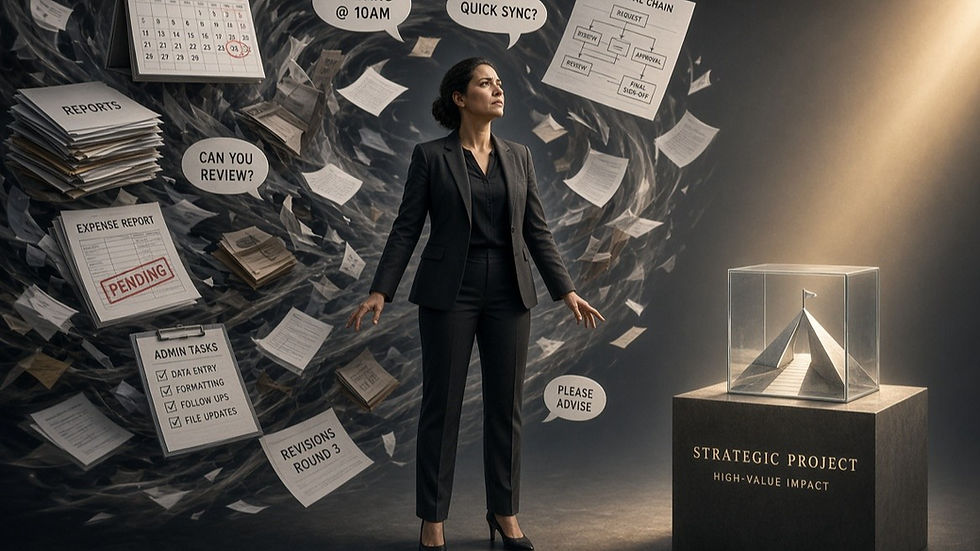
A project that made perfect sense three years ago is still running. A product that once generated significant growth now absorbs disproportionate management attention. A customer segment remains because nobody wants to be the person who recommends leaving it. A transformation programme continues because too much has already been invested to stop.
Meetings multiply. Reporting expands. Approval layers grow. Roles are created to manage the complexity created by everything else.
Nothing necessarily looks broken.
Yet the organisation becomes progressively harder to move.
Eventually, the CEO is no longer leading a clear strategy.
They are managing a portfolio of compromises, a collection of activities that once made sense, still have internal advocates, and are now consuming attention, capital and the organisation's best people.
This is how strategic focus erodes. Not through one catastrophic decision.
Through hundreds of reasonable decisions that are never reversed.
THE COST OF SAYING YES
The cost of an initiative is rarely just its budget. It is the leadership attention required to discuss it.
The people required to deliver it. The meetings required to coordinate it. The decisions that have to be made. The systems that have to support it. The exceptions it creates. The management capacity it consumes.
The opportunity it prevents the organisation from pursuing instead. This is the part of opportunity cost that can be difficult to see.
A company may have enough money to fund ten initiatives. It may not have enough organisational capacity to execute ten initiatives well.
That distinction matters.
You can buy another system. You cannot buy another three hours of your best executive's week. You can approve another project. You cannot create another group of exceptional people overnight. You can put another priority on the strategy document. You cannot make the organisation care equally about ten priorities.
At some point, something has to give.
When everything is important, the organisation usually solves the problem by spreading its best people across everything.
That can look like commitment.
Often it is dilution.
THE BEST PEOPLE ARE OFTEN THE FIRST CASUALTIES
This is one of the hidden costs of an overextended strategy.
The organisation doesn't necessarily run out of talent.
It overuses the talent it already has.
The same high-performing executives sit on every important programme. The same commercially capable people are asked to lead every new initiative. The same experienced managers become the people everyone calls when something needs fixing.
They are valued because they are capable.
Because they are capable, more gets given to them.
Eventually the organisation has its best people working on too many things at once.
Their calendars are full. Their attention is fragmented. Their ability to think deeply is reduced. They spend more time coordinating and less time creating.
The organisation then concludes that it needs more senior talent.
Sometimes it does.
The problem isn't a shortage of capability.
It is a shortage of focus.
Hiring another excellent person into an organisation that has not decided what matters most can simply create another excellent person who is spread too thinly.
WHY SUBTRACTION IS SO DIFFICULT
Stopping something sounds simple until you understand who is affected.
A long-standing customer may need to be told that the organisation will no longer serve them. A product team may learn that its investment is being closed. A senior executive may discover that their flagship initiative is no longer a priority.
People who have spent years building something may be asked to let it go.
Someone will have to explain why. Someone will be disappointed.
The person making the decision knows the initiative is no longer right but still feels uncomfortable ending it. That is the human core of strategic subtraction.
Most organisations already know, at some level, what they should stop doing.
The difficulty is that someone has to disappoint someone else to make it happen.
LEADERSHIP IS THE WILLINGNESS TO DISAPPOINT
Saying yes creates energy. It signals ambition. It gives people something to work towards.
It rarely creates an immediate enemy.
Saying no is different. It can look negative. It can disappoint people. It can create political resistance.
It can force a CEO to explain why something that was once important is no longer important enough.
That is why subtraction requires a different kind of leadership courage.
The CEO has to protect the capacity of the whole organisation, even when doing so means disappointing parts of it.
This is not about becoming conservative.
It is not about avoiding risk. It is not about refusing opportunities. It is about recognising that focus is itself a competitive advantage.
A strategy is not a list of everything the organisation could do.
It is a set of choices about what it will do, and what it will deliberately not do.
STOPPING SOMETHING IS NOT THE SAME AS ADMITTING FAILURE
There is an important distinction here.
Leaders sometimes resist stopping an initiative because they fear it will look like failure.
Circumstances change. Markets change. Customers change. Technology changes. Competitive dynamics change. The organisation itself changes.
Something that was strategically sensible two years ago may no longer deserve the same investment today.
Continuing it simply because it once made sense is not consistency.
It may be inertia.
Stopping can actually release value.
Capital becomes available. People become available. Management attention returns. Decision-making becomes simpler. The organisation becomes more capable of executing the priorities that remain.
The best investment decision a CEO can make is to stop funding something.
THE QUESTIONS THAT FORCE A CHOICE
The most valuable strategic questions are therefore not always the ones that generate new ideas.
They are the ones that force choices.
What are we doing that no longer creates enough value? Which customers should we stop serving? Which products or services should we stop funding? Which projects should we kill? Which meetings should disappear? Which decisions have become unnecessarily complicated? Which roles exist because of yesterday's organisation rather than today's strategy? Where are we spreading our best people too thinly?
The most revealing:
What are we continuing because it is strategically important, and what are we continuing because nobody wants to be responsible for stopping it?
That last distinction can expose an enormous amount of organisational waste.
THE CEO TEST
There is one question I would put to every leadership team: If we could only do half of what is currently on our strategic agenda, what would we stop?
Then ask the harder follow-up:
If the answer is “nothing”, do we genuinely believe everything on the agenda is equally important?
It is almost impossible for that to be true.
The question forces opportunity cost into the room. It makes leaders confront the fact that resources are finite. It exposes the difference between activity and progress. It brings the CEO back to the essential work of strategy:
deciding where the organisation's finite capacity will create the greatest value.
THE REAL WORK OF STRATEGY
The CEO's job is not to maximise the number of opportunities the organisation can pursue.
It is to make choices about where the organisation will focus its scarce resources, exceptional people and leadership attention.
That requires discipline.
It requires saying no to good ideas so the organisation has enough capacity to execute the great ones. It requires recognising when yesterday's priority has become today's distraction. It requires protecting talented people from being consumed by an ever-expanding list of commitments. It requires the courage to disappoint people when the interests of the whole organisation demand it.
That is not poor leadership.
That is leadership.
Every strategy contains a trade-off. Every commitment consumes capacity. Every priority pushes something else down the list. Every genuine choice means something will not be done.
THE QUESTION CEOs SHOULD BE ASKING
The most useful question in the next strategy meeting isn't: “What else should we do?”
It is: “What should we stop doing so that the things that matter most have a better chance of succeeding?”
That question changes the conversation.
It moves strategy away from accumulation and towards choice. It forces leaders to think about capacity rather than ambition. It makes opportunity cost visible. It gives the organisation permission to let go of things that no longer deserve its best people, its capital or its attention.
The hardest decision is rarely which new opportunity to pursue. It is deciding, with clarity and resolve, what the organisation will no longer do.
The path to greater growth is not adding another opportunity.
It is creating enough space for the right ones to succeed.
Comments